I am interested in the way our brains process and represent goal-directed actions and action features.
When acting alone, when interacting with others, and when perceiving actions of others.
Neural Representations of Actions
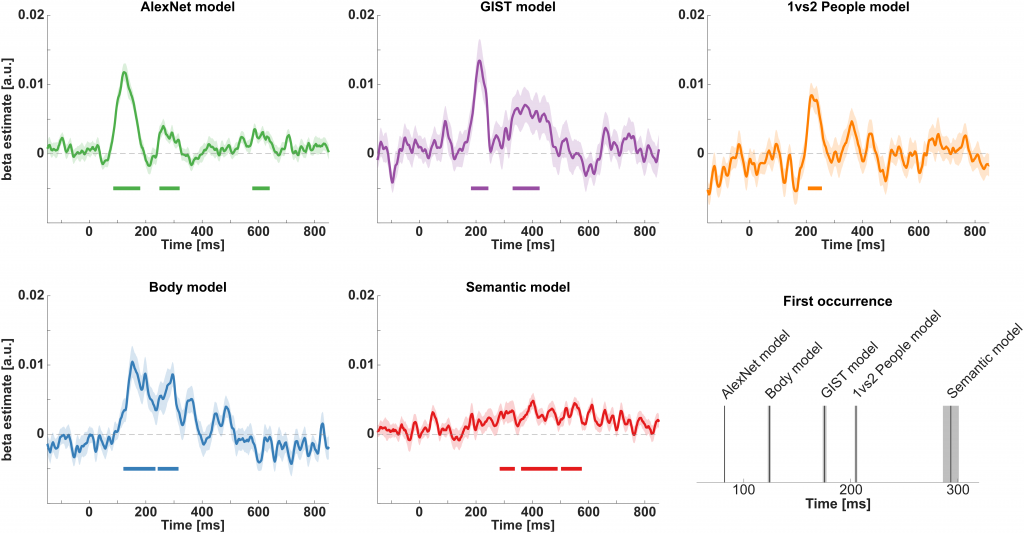
In this project we investigate how actions are represented in the brain, in particular the lateral occipitotemporal cortex (LOTC). We look at midlevel representations of action features, and how they build up over time, and study how different sources of information, such as actions, scenes and objects, are integrated during the perception of observed actions.
Moreover, we investigate how representations of actions are affected by short- and long-term modulations among groups and individuals, for example in response to learning in experts, or in response to situational changes in the (virtual) environment.
Social Interaction / Joint Action
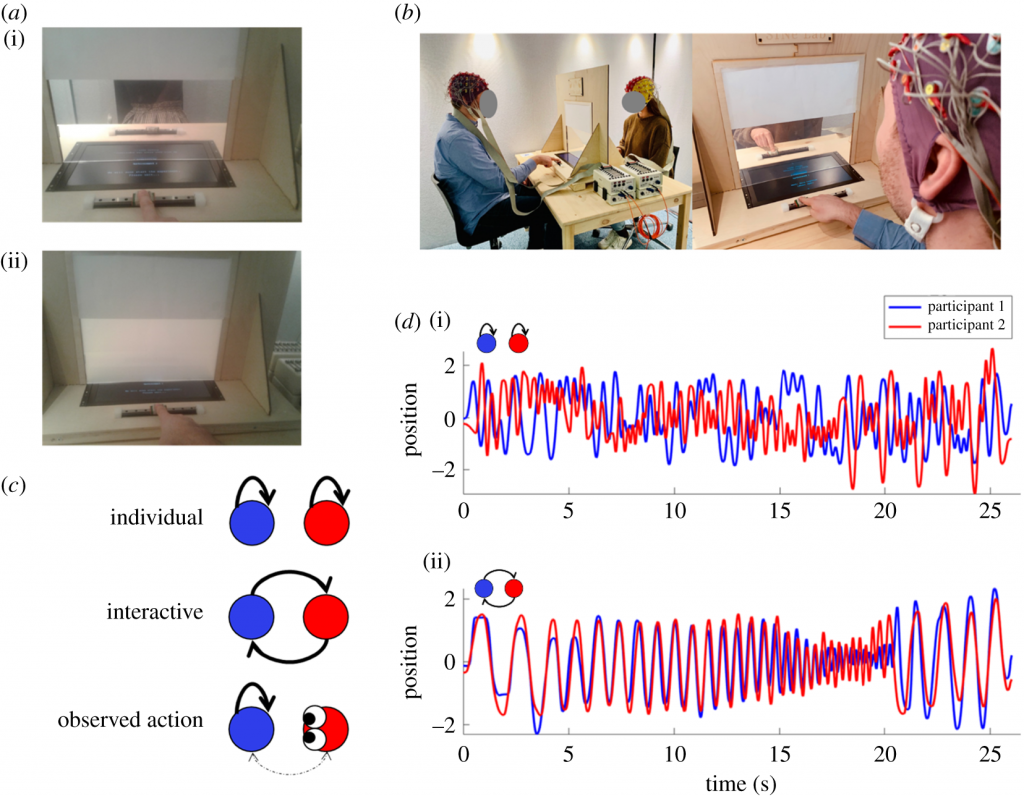
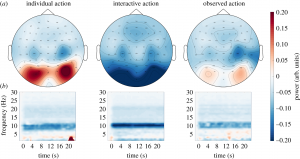
In this project we studied how players of the mirror game perform when acting alone, when they are observed and when they try to synchronize their movements. At the same time, we investigated the functional role of ongoing oscillations and inter-brain synchronization and microstates during interpersonal coordination.
Moreover, using real and simulated EEG data, we investigated how arbitrary methodological decisions can affect measures of inter-brain synchronization, and provided recommendations for future studies using these techniques.
From Action Goals to Action Plans
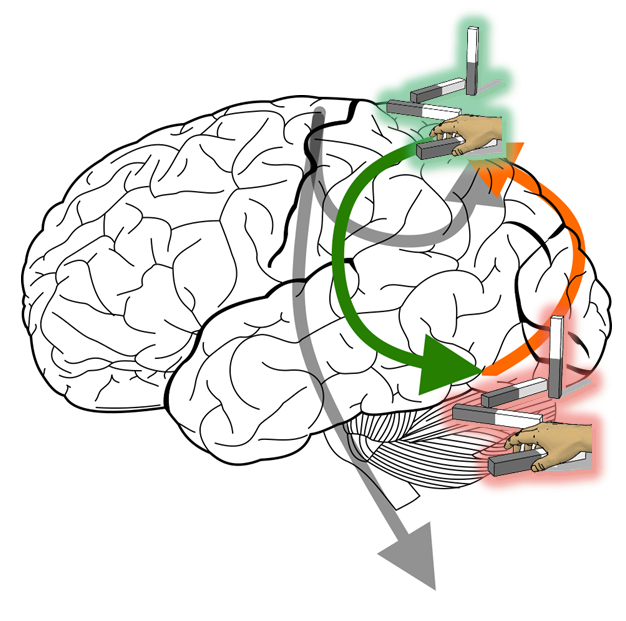
Using manipulations of body posture during action planning and action observation tasks we could show that both, planning and observing actions, rely on the same predictive mechanisms. The predictions implemented by this mechanism are based on the current physical configuration of the actors/obsevers body. Moreover, we could show that these predictions pertain to the goal state of the planned/oberved action, and involve neural processes in the extrastriate body area (EBA).
Notably, EBA has been defined as visual area involved in body perception. A number of studies showed that EBA is co-activated in motor control, however, the role of EBA in motor control remained unclear. In a series of studies using fMRI and TMS we showed that EBA represents desired goal states that can later be used by dorsal stream areas for the generation and execution of action plans.
A brain region’s function depends on its connections with other parts of the brain. We provide anatomical evidence, using resting-state fMRI and diffusion MRI, that EBA may indeed be involved in motor control tasks. Specifically, we could show that EBA has stronger connections with the dorsal visual stream involved in action planning, compared to other visually defined areas located in the ventral visual stream.
Methods & Techniques
EEG
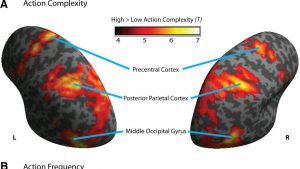
functional MRI
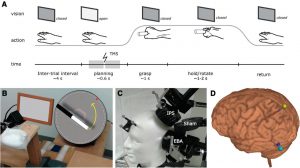
Brain stimulation
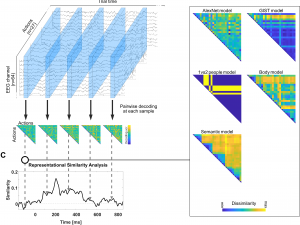
Representational
Similarity Analysis
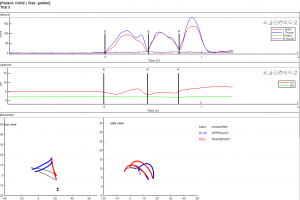
Kinematics
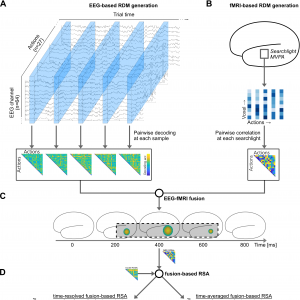
fMRI-EEG fusion
Publications
List of publications, talks and posters
Teaching and Supervision
I am teaching bachelor and master courses in psychology
Bachelor courses focus on empirical-experimental work within cognitive psychology, and reading seminars on current topics in cognitive psychology and neuroscience. I held stand-in lectures within undergraduate cognitive psychology courses.
Master courses focus on research methods, including Matlab courses for experimental control (Psychtoolbox) and data analysis of behavioural and EEG data (Fieldtrip). Moreover, I give courses on feedback and review within a researcher toolkit seminar series.
Supervision I supervise bachelor and master thesis projects within cognitive psychology, focussing on behavioural and neuroimaging (EEG) projects.
Information for BSc/MSc students: If you are a student (BSc or MSc) and are interested in conducting an internship on projects related to joint action, motor control, or action observation, do not hesitate to contact me. There are possibilities to conduct studies using movement based (especially motion tracking) and – if there is sufficient time – EEG based projects.
About Marius Zimmermann
Researcher/Lecturer (Akademischer Rat a.Z.)
Marius Zimmermann, PhD. Marius studied Psychology and Cognitive Neuroscience at the Radboud University Nijmegen in the Netherlands. He worked with Prof. Ivan Toni at the Donders Institute for Brain, Cognition and Behaviour where he obtained his PhD in cognitive neuroscience in 2016. He worked as a postdoctoral researcher at the Karolinska Institute and Stockholm University from 2017-2019. In 2019 Marius joined Prof. Ivana Konvalinka at the SineLab at DTU Copenhagen, Denmark. In 2021, he was appointed as Akademischer Rat (researcher and lecturer) at the Cognitive Neuroscience Lab of Prof. Angelika Lingnau at the University of Regensburg, Germany.
New paper in Psychonomic Bulletin & Review
Our work exploring how the (virtual) environment shapes the representational space of actions using Virtual Reality (VR) has been[…]
Preprint: Experience modulates action representations
In a new preprint we show how long-term experience with specific actions, such as in athletes, modulates how these[…]
CAOs 2026
Going to CAOs 2026 in Rovereto, Italy, to present some recent projects on dynamic action representations.
New preprint using Virtual Reality
A new preprint of our Virtual Reality study investigating how VR scene context affects the representational space of actions[…]